TITLE: Pannicullectomy: More than A Tummy Tuck
BIBLIOGRAPHY: Gallagher, Susan. “Pannicullectomy: More than A Tummy Tuck”. Nursing 2004 Vol.34 No.12 December. Lippincott Williams and Wilkins: 323 Norristown Road, Suite 200, Ambler PA 190022758 © 2004. pp 48-50
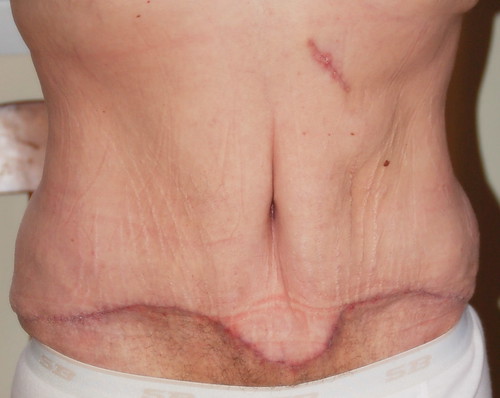
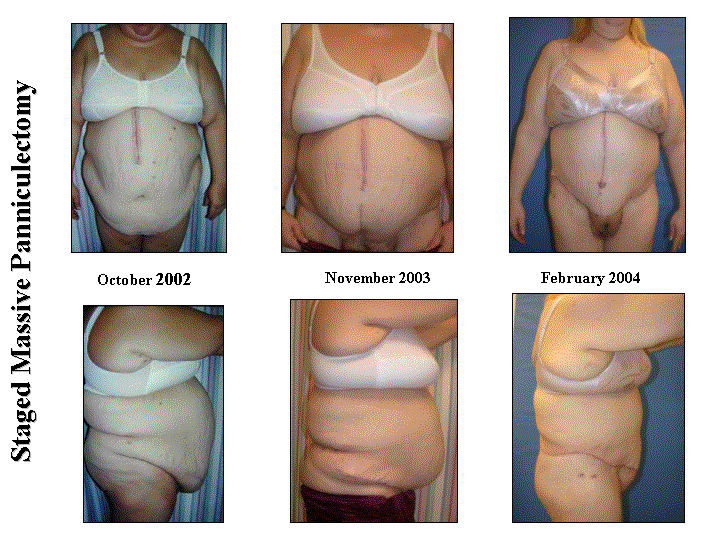
SUMMARY: The article is about an obese patient who developed a problem after massive weight loss. this problem is called abdominal pannus describe as a layer of subcutaneous fat that can weigh up to 100 pounds, depending on how much weight a patient lost. The fat and extra skin that remains after weight loss can cause medical and physiological problems that impair function and quality of life. Panniculectomy is done to have a successful weight loss but before doing it the patient must be nutritionally stable, must quit smoking and have enough money. And also, the patient must familiarize herself with the equipments she will use after the surgery. Panniculectomy has a nickname of “tummy tuck” that’s why it is sometimes thought as an elective cosmetic surgery. The nurse’s role before the procedure is to assess the patient for risk factors and contraindications. In form the patient about the surgery and what to expect from it. Advise him/her that he may have a postoperative pain that requires taking a medicine. After the procedure, the patient’s vital signs, signs and symptoms of complications are strictly monitored. The patient is allowed to ambulate within 8 hours after the surgery. If the patient’s mobility is limited, he/she may need treatment with a sequential compression device to prevent DVT or full-body rotation therapy to prevent postoperative atelectasis. Patients must be encourage to splint his incision, to cough and to deep breathe and to use incentive spirometry. As this surgery benefits the patient it can also threaten ones life because of its complications such as, atelectasis, DVT, skin breakdown and pulmonary embolism. When panniculectomy surgery finished patient will have a T-shaped surgical wound. The patient wound must be monitored for wound drains to prevent wound dehiscence, seroma formation and infection, it should be always clean especially those in skin folds. The nurse assess for wound separation especially around the low mid point of the T in the abdominal incision. Teach the patient to use abdominal binder for the first 4 weeks after surgey to prevent complications. Finally, the patient must be reminded that weight loss surgery is just a tool in the battle against excess body weight. He/she must have follow up check up and must ask his doctor about dietary and lifestyle changes that will aid him to keep the weight off permanently. One of the important things a nurse should do in this kind of surgery is to provide emotional support through out the patients hospital stay by maintaining his dignity and respecting his privacy because he may be embarrassed by his condition.
REACTION: Panniculectomy is but a strange new thing to me because I never knew what it was before. Now, I learned that panniculectomy is a plastic surgery procedure that removes hanging fat and skin, that might be the result of diet and exercise, or because of successful bariatic weight loss surgery. The procedure can also help people who suffer from an overly large and hanging mid-section. In an obese person, there can be a large apron (abdominal pannus) of excess fat and skin that hangs down from the lower abdomen. At times, this apron is so large that it covers the hips and extends around to the lower back. The apron can be graded on a 1-5 scale. Generally, higher grades occur as the weight of the patient increase. Also, the higher grades tend to have more problems and medical, physical and social limitations. As what I have observed, when the grade increases problems such as difficulty getting in and out of bed, and standing and walking upright ensue. Medical problems such as excess weight and moisture leading to skin rashes and breakdown, back pain and loss of abdominal wall integrity may also occur. For me, the best candidate for panniculectomy is those people who suffer from obesity, or have recently experienced significant weight loss, or suffer postpregnancy issues with inordinate fat localized below the belly button. These condition may interfere with their everyday life because it may be difficult for them to walk, stand and sit with other people watching. The candidates must have a stable weight, participate in a proper dietary and exercise plan. In order to have a successful surgery, the candidates should select a board-certified plastic surgeon. A qualified plastic surgeon will help to ensure that a panniculectomy is appropriate for a candidate condition and can also increase a candidate odds of success and reduce the risk of complications. In my opinion, it is important to choose a certified plastic surgeon who has extensive specific panniculectomy experience as well as expertise in all areas of abdominal plastic surgery. A certified surgeon may not always guarantee the best results, however, to become a certified surgeon require a specific and rigorous surgical education and training which can help the candidates to achieve a safe and successful outcome. As I read the article, I know that this kind of surgery can benefit some people but it can also lead to complications. The most common complication from panniculectomy include infection, bleeding, and excessive scarring. If these occur, the best thing a candidate can do is to tell her surgeon immediately. If ever I’ll encounter a patient who had undergone panniculectomy, I’ll do a close monitoring to her vital signs, for possible signs and symptoms of complications and to her surgical wound. I’ll encourage her to walk and to perform deep breathing exercise to prevent atelectasis. And as a nurse I will ensure that my patient will receive an adequate nutrition and hydration. I will also teach her how to clean her surgical wound to prevent infection. And most importantly, I will provide emotional support to maintain her dignity. When the surgery is finished the surgeon will supply a complete postoperative instruction list to follow to reduce the risk of complications, like restricting the patient to exercise and to lift heavy object. I learned that after panniculectomy the patient is required to stay in the hospital because of the extensive nature of the surgery as well as the need for more medical attention during recovery. And also, after surgery the patient most certainly will have to take time off from work. The complete wound healing may take several months. In conclusion, panniculectomy can be good or bad depends on its outcome. It is good because it can benefit people who have had massive weight loss that causes to have a hanging fat and skin. It is bad when deadly complications continue to develop. In my opinion, before proceeding to panniculectomy one should view before and after photos of patients who received such kind of surgery and also she should inquire more about the method of the procedure and possible complications from surgery.
